The world is made of numbers.
The test scores at school, the price of books and games, bus lines are just some examples. When we were young learned to count and we had to do with your fingers. This really was no problem. When we asked how many years we could answer four without speaking, and everyone understood that our age was four years.
grew up and we do not need fingers to count, but the school turned to a problem.
begin to add and returned to the fingers to be sure of the result. But as the numbers were great, the hands can not hit us.
To what number can be counted using the fingers?
No doubt you can make 10 because that is the number of fingers you have on hand. If we can
skillfully moving toes could count to 20. If we use our memory could repeat the process and count to 40. To move beyond this number will have to make a greater effort to remember and most likely misnomer.
Two years after Columbus came to America over 500 years ago, an Italian mathematician, Luca Paccioli summed up in one of his most famous books, a system with only 18 different positions of the fingers gives us from 1 to 9,999. How is it possible? Let
which is the system that Pacioli propose:
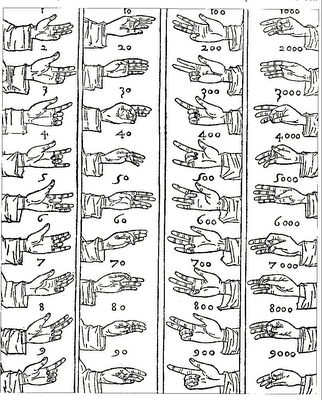
If have see that there are 36 figures to represent units, tens, hundreds and thousands'
If we look at the columns corresponding to the units next to the hundreds for We see for example the symbol for the 1 that is performed with the left hand is equal to the symbol of 100, only this is done with the right hand. To memorize the positions of the fingers of the column that describes the numbers 1 through 9, we know the positions of the fingers of the hundreds that go from 100 to 900. The same can be done by comparing the columns with tens of thousands. Therefore the 36 figures in the table represent only 18 different positions. There are 36 tables for 18 of them belong to the right and the other 18 to the left.
This and other systems for finger counting was used in times where not only had no calculators. Also was either impossible or difficult to access the paper.


0 comments:
Post a Comment